Dissecting an SF-50: Part 1
Take Ownership of your Career.

SF-50s (Standard Forms 50s) are the most important documents you will receive during your federal career. Nearly every personnel action is documented with an SF-50, and those SF-50s are collectively filed in your Official Personnel File (OPF). They contain important information about your position, pay, benefits, and entitlements.
I recommend every federal employee download and review their OPF periodically, or at a minimum, anytime they experience a significant career event, which could include a new appointment, promotion, suspension, termination, or other similar action. (Read this blog post to learn why keeping a copy of your SF-50s is so important: Four Myths About Human Resources)
In this two-part series, I am going to review the most significant blocks of the SF-50 to help you understand how they shape and define your career. In today’s climate, it is more important than ever to educate yourself and take ownership of your federal career. You are your best advocate!
The Basics: SF-50 vs. SF-52


First, it is important to understand the difference between an SF-52 and an SF-50. You have likely heard both terms used by members of your agency’s Human Resources office. An SF-52 is a form that documents the agency’s request for a personnel action, and an SF-50 is the notification of a personnel action, meaning it documents that the action was actually processed.
If you have told a Human Resources specialist that you wished to retire or resign from federal service, they may have asked you to sign an SF-52. This is their way of documenting that you are requesting that the agency process this type of action. In actions that are not initiated by the employee (examples: within grade increase, award, or suspension), the request is authorized by an agency official.
When you review your OPF, you should generally see both forms (an SF-52 and an SF-50) for each type of personnel action. This is why it might appear that there are duplicates, but they are separate and distinct documents. One form documents the request, and one form documents the final action.
This post focuses on the SF-50, because those are the forms that are generally requested from third parties. It is important that you provide an SF-50 (not an SF-52) if you are asked for documentation that a personnel action occurred. For example, you will likely be asked for your last SF-50 when you apply for a new federal job or file an appeal with the Merit Systems Protection Board (MSPB). You may also be asked for recent SF-50s if you are working with a federal employment law attorney on an employment matter.
Now that you understand the purpose of the SF-50, we are going to take a closer look at the information documented on the form. In each section below, I will use a sample SF-50 that I created for our fictional friend, Flora M. Fed. Flora is currently a GS-9 in a career ladder position that has promotion potential to a GS-12. A career ladder position is a position that is announced and filled on a competitive basis with promotion potential to higher grade levels on a non-competitive basis. Here, Flora was initially hired as a GS-9, but she is eligible for a non-competitive promotion to a GS-11 after one year, and then she will be eligible for a second non-competitive promotion to a GS-12 another year after that. In this example, Flora has been approved for her career ladder promotion to a GS-11. We are going to follow along to see how her personnel action is documented, and what other critical information she can find on her SF-50.
Personal Identifiers (Blocks 1- 3)

The first three blocks are self-explanatory. They include your name, social security number (SSN), and date of birth (DOB). You can see Flora’s name, SSN and DOB are captured above in red. (We’ll get to Block 4 in the next section).
It may sound obvious, but you should always verify that your name, SSN, and DOB are correct. Unfortunately, I have seen SF-50s filed in the wrong employee’s OPF – remember, humans are not perfect! Also, do not forget to redact your SSN and DOB when transmitting your SF-50 to third parties. Your Human Resources team should also not send you an SF-50 via an unsecured method. It should be password protected, transferred through a secure file transfer system, sent via encrypted email, or your SSN and DOB should be redacted.
The Personnel Action (Blocks 4-6, 45)

Next, we will look at the blocks that document the type of personnel action processed. The effective date of the personnel action is documented in Block 4. While it seems simple, this date is quite powerful. For example, if the SF-50 documents the start of a new government position, then this date may be used to determine your overall length of federal service, time served in a probationary or trial period, time in grade, annual leave accrual rate, within-grade increase eligibility, or retirement eligibility. It is critical that effective dates are correct to ensure your benefits and entitlements are calculated accurately. For Flora, the effective date of her promotion is 6/15/2026. This is the start date that will be used to calculate her time as a GS-11 for time-in-grade purposes, and it will be used to calculate time spent waiting for her within-grade increase as a GS-11.
The type or “nature” of the personnel action is explained in Blocks 5 and 6. Note that Block 6 is labeled “Second Action,” so it is only used if more than one personnel action is processed at the same time. (This might occur if there is a cancellation. For example, if there is an error in your personnel file, the agency will cancel the erroneous action and re-process it correctly. Both actions may show on the same SF-50.)
Each type of personnel action has a specific numerical code, called a “nature of action code” or NOAC, which is listed in Block 5A (or 6A if there are two actions). These codes are determined by the Office of Personnel Management (OPM) and listed in their Guide to Processing Personnel Actions (GPPA). A narrative description of the action can be found in Block 5B (or 6B if there are two actions).
Most personnel actions must also include a citation to the legal authority that supports the agency action. This can be found in Blocks 5C to 5F (or 6C to 6F if there are two actions). Often this is a citation to the Code of Federal Regulations (CFR) or the United States Code. For example, if a non-probationary employee is removed from federal service, then the legal authority code is likely a citation to 5 U.S.C. Chapter 75, which governs adverse actions for most federal employees. Your agency is responsible for including the legal authority citation, if required.
For Flora, the NOAC for her promotion is 702 and the legal authority for the agency to take this action can be found at 5 CFR 335.102.
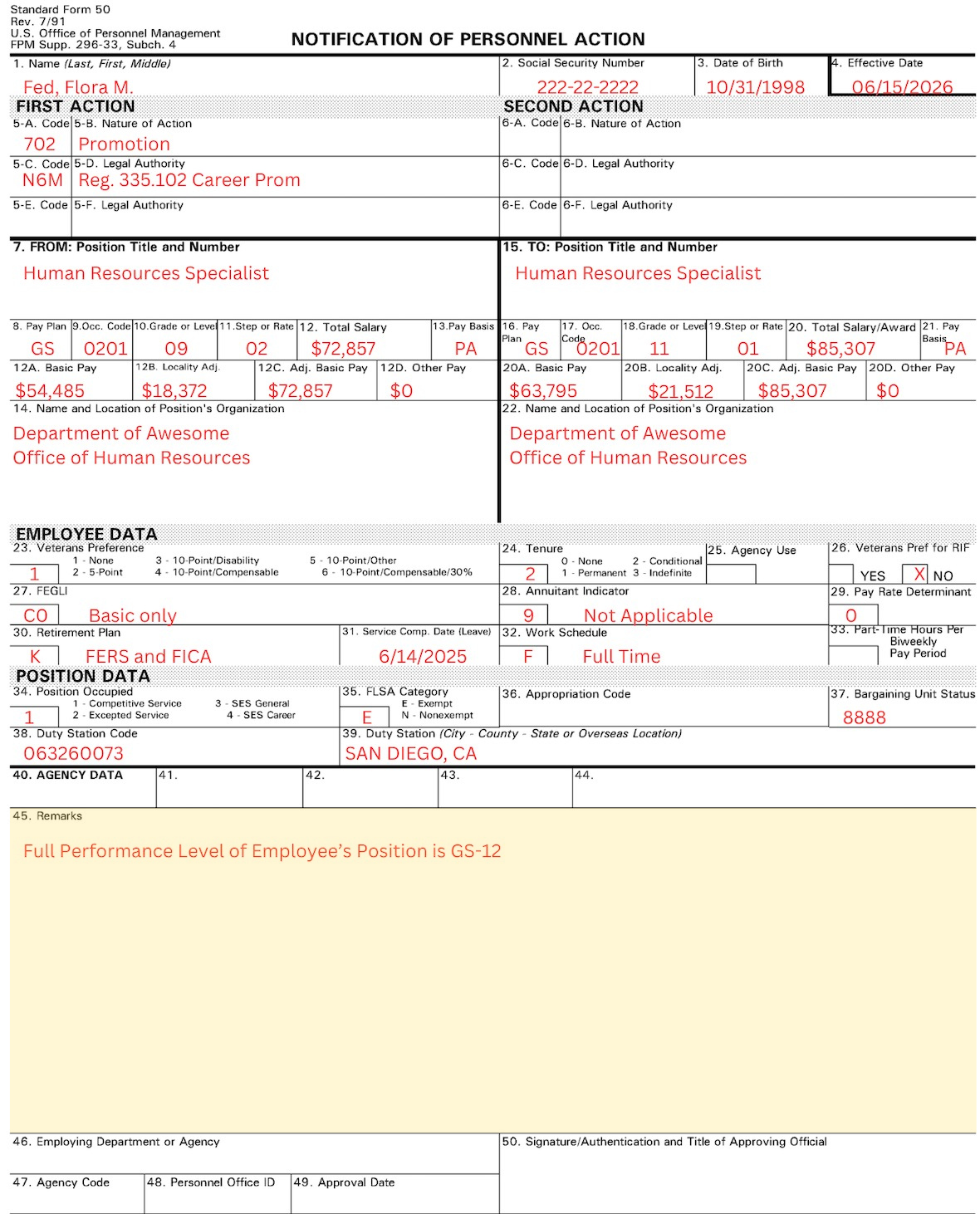
Finally, Block 45 is a section that includes remarks specific to your particular type of personnel action. OPM directs agencies to include certain comments based on the type of personnel action. The comments may include information about benefits eligibility, creditable military service, retirement coverage, and more. This section is especially important in your initial appointment SF-50, because it should state whether you are subject to a probationary or trial period and how long that period lasts. It is very important to check your appointment SF-50 when you start a new federal position to verify that your probationary or trial period is documented correctly. If you believe your SF-50 is incorrect because you have prior federal service that should be counted towards your probationary or trial period, it is important to contact your Human Resources team and get your records updated early. Do not wait until the agency tries to take an action to request an update of your records!
For Flora’s SF-50, one required remark for a career ladder promotion is the full performance level for the position. As mentioned earlier, Flora is on a GS-9/11/12 career ladder position, and the full performance level of her position is a GS-12.

The Next Installment.
There is a lot more to unpack. In Part Two, I will cover the SF-50 sections that document your federal position, pay, and other critical information that may define your rights - including bargaining unit status and veterans' preference. Remember, these are not just bureaucratic checkboxes – they are the foundation of your rights as a federal employee.
I'll see you in the next post, but in the meantime, go take a look at your OPF. You might be surprised by what you find.