Dissecting an SF-50: Part 2
Take Ownership of your Career.

Understanding your official personnel file, including the components of the SF-50s that make up that personnel file, is critical to understanding your rights as a federal employee. In today’s climate, it is more important than ever to arm yourself with information and be your own advocate.
In Part One, we just scratched the surface. We reviewed the difference between an SF-50 and SF-52, your personal identifiers, and information specific to the types of personnel actions documented in your SF-50s. (Read Dissecting an SF-50: Part 1 if you missed it). Today, I will close out this series by focusing on your federal position, pay, and other important blocks that can define your rights and protections as a federal employee.
We will again follow along with a sample SF-50 created for our fictional friend, Flora M. Fed. As a reminder, Flora is a GS-9 Human Resources Specialist that has been approved for a career ladder promotion to a GS-11. We will use her latest SF-50 to see how her promotion was documented and uncover other critical information captured on her SF-50.
Your Federal Position (Blocks 7-11, 15-19)

Every SF-50 will describe your current position and pay in Blocks 17-22, even if the personnel action documented by the SF-50 does not change your position or pay.
You will notice that Blocks 7-14 are nearly identical to Blocks 15-22. Blocks 7-14 are the “FROM” blocks (documenting your prior position and pay) while Blocks 15-22 are the “TO” blocks (documenting the new position and pay resulting from the personnel action, if applicable). Depending on the type of action, only one section (Blocks 7-14 or Blocks 15-22) or both sections may be filled out. For example, if you are changing positions, both sections will be filled out. Blocks 7-14 will include information about your old position and Blocks 15-22 will include information about your new position.
In our example, Flora is being promoted from a GS-9 to a GS-11, so Blocks 7-14 document her GS-9 position and pay and Blocks 15-22 document her new GS-11 position and pay. Now, we will take a closer look at the individual blocks that describe your position.

First, your position title is documented in Block 7 and/or 15. It is important to note that this is your official title, and it should match the title listed on your position description. You might go by a different title in the workplace; however, that title would be considered your “organizational title” and not your “official title.” For example, your SF-50 might state that you are a “Program Analyst,” but the title in your signature block might incorporate the name of the specific program you support. Flora’s official title is “Human Resources Specialist.”

Your pay plan, occupational code, grade, and step are documented in Blocks 8-11 and 16-19.
Your pay plan is the specific type of pay system that your position falls under. Most federal employees are covered by the General Schedule (GS) pay plan. Other pay plans may include the Federal Wage System (WG, GL, or WS) and Executive Schedule (ES). Flora is a GS employee.
Your occupational code corresponds to your specific job type, which is based on the type of work performed, required skills, and educational qualifications. These codes are set by the Office of Personnel Management (OPM). You may also hear them referred to as your “occupational series.” Common examples include:
0343 (Management and Program Analysis),
1102 (Contracting),
0501 (Financial Administration),
2210 (Information Technology Management), and
0201 (Human Resources Management – Flora’s occupational series!)
Your grade reflects your rank and level of responsibility, and it dictates your base pay. For example, under the GS pay scale, employees are divided into 15 grades (GS-1 to GS-15) with GS-1 having the lowest level of responsibility and lowest pay and GS-15 having the highest level of responsibility and highest pay. Flora is a GS-9 and she is being promoted to a GS-11, which increases both her pay and responsibility.
Your step refers to pay increments within your specific grade. For example, under the GS pay scale, each grade has 10 steps. Higher step means higher pay. Typically, employees are hired at step 1 of their grade, and they receive periodic increases to the next step as long as they are performing acceptably. Remember that waiting periods vary between steps. Under the GS pay scale, employees must wait 52 weeks to advance to steps 2-4, 104 weeks to advance to steps 5-7, and 156 weeks to advance to steps 8-10. In our example, Flora was a GS-09, Step 2, because she had spent 52 weeks as a GS-9, Step 1. Now, because she is being promoted to a GS-11, she must go back down to a Step 1 at her higher grade level. She will have to wait another 52 weeks to advance to a GS-11, step 2.
Your Federal Pay (Blocks 12 and 20).

Next, we are going to take a closer look at your federal pay. Blocks 12 and 20 collectively break down your compensation. Total salary (Blocks 12 and 20) is your overall compensation while the A, B, C, and D blocks break down the various components of your pay. Your basic pay (12A and 20A) is the base pay that employees in your pay plan, grade, and step receive. Your locality pay (12B and 20B) is the additional pay you receive based on the cost of living in your assigned duty station. OPM publishes locality pay tables for the GS pay plan here. While most major cities are included in a locality pay table, keep in mind that not all locations are covered. Adjusted basic pay (12C and 20C) combines your base pay and locality pay. Other pay (12D and 20D) includes any other allowances or differentials not captured by your base pay or locality pay. Examples may include law enforcement availability pay and hazardous duty pay.
For Flora, you can see that her base pay (Blocks 12A and 20A) increased from $54,485 to $63,795 when she was promoted from a GS-9 to a GS-11. Her locality pay, which is based on the San Diego locality pay table, also increased. Locality pay is a percentage increase of your base salary, so your locality pay increases when your base salary increases. For example, the San Diego locality pay rate is 33.72% of base pay, so Flora’s locality pay adds an additional 33.72% of her base pay (which is $21,512 as a newly promoted GS-11, see Block 20B). Flora does not have any allowances or differentials documented in Blocks 12D or 20D.
Other Notable Information.
Your SF-50 also contains a host of valuable information about your rights and entitlements in the “Employee Data” and “Position Data” sections. Below are notable items.

Veterans Preference is documented in Block 23 and Veterans Preference for RIF is documented in Block 26. It is important to ensure your agency has correctly documented your military service in these sections. In most cases, agencies are relying on employees to provide documentation to support military service, because agencies do not have independent access to your military records. If these sections are incorrect, request correction from your Human Resources team. Your Veterans Preference status can impact future job eligibility and your rights of redress. It is also especially important to ensure the Veterans Preference for RIF section is correct given recent, government-wide downsizing efforts; however, be aware that not all veterans receive preference in a RIF. Preference eligibility may depend on your length and type of military service, type of discharge, rank at discharge, and other factors. Flora’s SF-50 documents no prior military service.

Your Service Computation Date (Leave) can be found in Block 31. It is important to note that this is only your service computation date (SCD) for leave purposes. It is used to determine how much annual leave you accrue each pay period (4, 6, or 8 hours per pay period). For many, this date may correspond with your years of service for retirement, but not always. For example, an employee may have non-federal or military service credited for annual leave accrual which does not count towards years of service for retirement. In that case, their SCD for leave purposes would not match their SCD for retirement.
Here, Flora’s SCD for leave purposes is 6/14/2025, which is also the date of her first appointment to her career ladder position. We can tell that Flora does not have any prior non-federal or military service because this date matches the start of her first appointment. Therefore, it is her SCD for both leave and retirement.
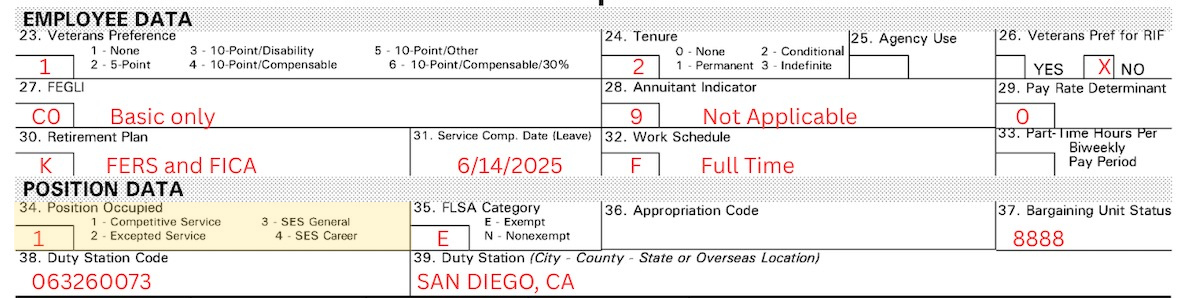
The Position Occupied in Block 34 identifies whether your position is in the competitive or excepted service. The competitive service covers most federal executive branch positions. Applicants must go through a competitive hiring process. Excepted service positions are exempt from competitive hiring procedures. Agencies may use their own procedures for these positions; however, selections must still be merit based. Excepted service employees generally have less job protections than competitive service employees. (Read this post to learn what job protections employees who are transitioned to Schedule Policy/Career (P/C) of the excepted service will lose: The Calm Before the Storm). Flora is in a competitive service position.

Bargaining Unit Status is another important section that identifies whether your position is represented by a labor union. Over 40% of federal jobs are covered by a bargaining unit (union). If your position is not represented, then you will likely see 8888 (which means that your position is ineligible for inclusion) or 7777 (your position is eligible for inclusion, but no bargaining unit currently exists) in Block 33. These codes are called Bargaining Unit Status (BUS) codes. If you have a code other than 8888 or 7777 and you are not sure which union represents your position, you can look it up here. Flora has an 8888 BUS code which means that her position is ineligible for inclusion in a bargaining unit. Human resources positions are often excluded from bargaining units under 5 USC 7112 (b)(3) because they are engaged in personnel work.

Your Duty Station is the work location that you are officially assigned to, and it can be found on Blocks 38-39. Your duty station drives your locality pay (Blocks 12B and 20B). These blocks were especially important after the January 2025 return-to-office directive. Employees approved to work remotely should have been officially assigned to their alternative work site, which would have been reflected in Blocks 38-39. This meant that employees were paid based on the location of their alternative work site (often their home) and not the agency’s primary geographic location. Since January 2025, many employees have been reassigned to new duty stations to comply with the return-to-office directive. Blocks 38-39 of their SF-50s should have been updated when their duty station changed, and this would have also changed their locality pay. Here, Flora’s official duty station is San Diego. Remember that we saw this location used earlier to determine her locality pay in Blocks 12B and 20B.

Forewarned is Forearmed.
Your SF-50 is a gold mine of information that defines your federal career. In this series, we have covered the processing and documentation of personnel actions, including the importance of effective dates, supporting legal authority, and remarks; vital information about the nature of your federal position and compensation; and other critical information that can define your rights and entitlements, including bargaining unit status, veterans preference, service computation date, and more.
Remember – do not put off till tomorrow what you can (and should) do today. Review your personnel file early and often. Ask questions. Request updates as soon as possible if you discover inaccurate information. Waiting until something goes wrong to understand your records is a risk you cannot afford.